61 Princeton Hightstown Rd, Unit-2C, Princeton Junction, NJ 08550

61 Princeton Hightstown Rd, Unit-2C, Princeton Junction, NJ 08550
Serving Princeton, NJ and Surrounding Communities.
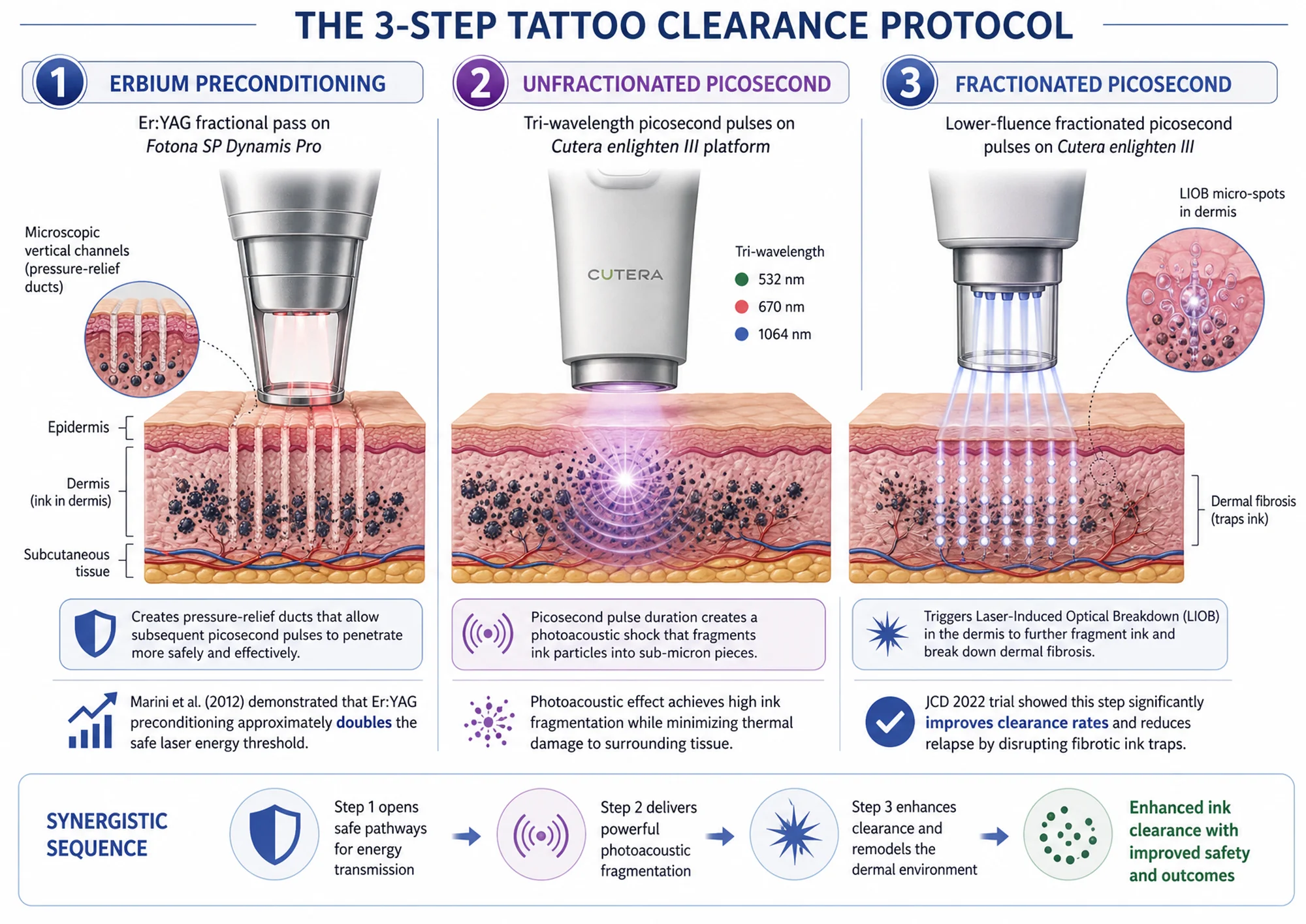
The treatment begins with a fractional Er:YAG pass on the Fotona SP Dynamis Pro that creates microscopic channels through the epidermis above the tattoo. Published peer-reviewed data (Marini et al., 2012) show that this preconditioning step approximately doubles the safe laser energy the skin can tolerate. The microchannels act as pressure relief ducts that allow gases from thermal ink decomposition to escape, preventing the sub-epidermal blistering that limits single-laser tattoo removal.
Following the preconditioning step, tri-wavelength picosecond delivery on the Cutera enlighten III platform targets the full color spectrum of tattoo inks. Three wavelengths (1064 nm, 532 nm, and 670 nm) are used in calibrated combinations matched to each tattoo's specific ink colors. The picosecond pulse duration generates a photoacoustic shock that fragments ink particles into sizes the immune system can clear.
The third step applies fractionated picosecond delivery at lower fluence using the Cutera enlighten III's microlens array. Laser-Induced Optical Breakdown creates discrete sub-cellular cavitation zones in the dermis that promote collagen remodeling, break down dermal fibrosis trapping ink, and accelerate clearance. Published clinical data (Journal of Cosmetic Dermatology, 2022) demonstrate this step improves clearance rates from 69.2 to 84.6 percent over three sessions versus unfractionated picosecond alone.

TattooLase treats body and cosmetic tattoos across all colors, ink types, and ages. Each session sequences three laser steps: fractional Er:YAG preconditioning on the Fotona SP Dynamis Pro, tri-wavelength unfractionated picosecond on the Cutera enlighten III, and fractionated picosecond at lower fluence on the same enlighten III platform. Most patients complete a course in four to eight sessions spaced six to eight weeks apart, compared with five to twelve sessions typical for picosecond-only protocols.
TattooLase addresses dense professional tattoos, multicolored body art, cosmetic tattoos, traumatic tattoos, scarred tattoos, and tattoos that have stalled with prior picosecond-only treatment. The Erbium preconditioning step makes safe treatment of darker Fitzpatrick skin types possible at energies that single-laser protocols cannot tolerate without scarring.
For patients with simpler tattoos who do not require the advanced three-step protocol, we also offer Enlighten Tattoo Removal using the same Cutera enlighten III platform without the Erbium preconditioning step.
TattooLase is not a single device or a packaged manufacturer protocol. It is a physician-designed three-laser sequence built around the published clinical evidence for combining fractional Erbium preconditioning with picosecond tattoo removal. Designed by Dr. Jetty, performed only at Princeton Aesthetics.
Published clinical data (Marini et al., 2012) document approximately thirty percent fewer treatment sessions for tattoo clearance when fractional Er:YAG preconditioning is added to picosecond protocols. Most TattooLase courses are completed in four to eight sessions versus five to twelve typical for picosecond-only treatment.
Marini et al. (2012) demonstrated that fractional Er:YAG preconditioning approximately doubles the skin's safe laser energy threshold. This means each session can deliver significantly more clearance work without the sub-epidermal blistering that single-laser tattoo removal protocols develop at higher energies.
The Journal of Cosmetic Dermatology (2022) demonstrated that combining fractionated and unfractionated picosecond delivery improves fifty-percent-clearance rates from 69.2 percent to 84.6 percent over three sessions. TattooLase incorporates both modes plus the Erbium preconditioning step.
Every TattooLase session is performed by Dr. Jetty personally. The protocol's core mechanisms (Erbium preconditioning, picosecond photoacoustics, fractionated picosecond LIOB) are each supported by peer-reviewed clinical evidence. We can show you the studies that support every claim we make.
The combination is what makes TattooLase work. Published clinical evidence supports each step individually; TattooLase brings all three together into one physician-designed protocol available only at Princeton Aesthetics.
Each session begins with a fractional Er:YAG pass on the Fotona SP Dynamis Pro. The Er:YAG laser creates microscopic vertical channels through the epidermis that act as pressure-relief ducts. Marini et al. (2012) showed this approximately doubles the safe laser energy threshold.
Calibrated tri-wavelength picosecond pulses on the Cutera enlighten III platform are delivered across the tattoo. The picosecond pulse duration creates a photoacoustic shock that fragments ink particles into sub-micron pieces.
Lower-fluence fractionated picosecond delivery triggers Laser-Induced Optical Breakdown in the dermis. The JCD 2022 trial showed this step improves clearance rates and breaks down dermal fibrosis that traps ink.
1064 nm, 532 nm, 670 nm
Three wavelengths cover the full ink color spectrum, including resistant cool tones that two-wavelength systems leave behind.
Fitzpatrick I through VI
The 1064 nm wavelength used at the core of the protocol carries the broadest published safety record for darker skin tones.
Scarred and previously-treated tattoos
The fractionated picosecond step breaks down the dense dermal fibrosis from prior tattooing or removal attempts that traps ink and stalls standard protocols.
Lymphatic drainage over weeks
Fragmented ink particles are cleared by macrophage phagocytosis and lymphatic drainage in the four to eight weeks following each session.
Two stacked treatments per session
The preconditioning step permits multiple high-fluence picosecond passes in the same session. Marini et al. confirmed two stacked treatments is the optimal point.
Across four to eight sessions, the combined effect of these three modalities produces faster and more complete tattoo clearance with lower scarring risk than single-laser protocols. Dr. Jetty reviews progress at every visit and adjusts the protocol as the tattoo responds.
The Fractional Erbium laser creates microchannels in the skin, directly removing some tattoo pigment and minimizing the risk of complications such as blistering.
Unfractionated picosecond technology delivers high-energy tri-wavelength pulses to break down remaining ink particles, aiding in their clearance.
The fractional pico treatment uses ultra-short pulses to create Laser-Induced Optical Breakdown, effectively fragmenting residual pigments and breaking down dermal fibrosis.
The body engages its immune response to clear fragmented pigments while fibroblast activity promotes collagen and elastin production for skin recovery.
High ink saturation, dense dark lines
Patients whose professional tattoos have stalled or are progressing too slowly with picosecond-only treatment.
Stubborn blues, greens, layered ink
The fractionated picosecond step addresses dense layered ink that standard treatment cannot fully reach.
Scar tissue trapping ink
TattooLase actively treats the scar tissue itself, making it the strongly preferred protocol for these cases.
Every candidate is reviewed by Dr. Jetty before any session begins. For simpler tattoos that do not require the advanced three-step protocol, the option to use Standard Enlighten Tattoo Removal is available.
TattooLase was built from the ground up by Dr. Siva Teja Jetty, MD, not licensed from a device manufacturer. Every parameter of the three-laser sequence was developed at Princeton Aesthetics.
No technicians, no delegated steps. Every TattooLase session is delivered personally by Dr. Jetty, the physician who designed the protocol.
Each step of TattooLase is supported by peer-reviewed clinical literature (Marini et al., 2012; Journal of Cosmetic Dermatology, 2022). We can show you the studies that support every claim we make.
Fotona SP Dynamis Pro for Erbium preconditioning. Cutera enlighten III for both unfractionated and fractionated picosecond delivery.
The Nd:YAG 1064 nm wavelength used at the core of the protocol carries the broadest published safety record in Fitzpatrick IV through VI skin.
Published data document approximately thirty percent fewer treatment sessions for tattoo clearance compared with picosecond-only protocols (Marini et al., 2012).
If your tattoo is appropriate for standard care, we also offer Enlighten Tattoo Removal on the same Cutera enlighten III platform without the Erbium preconditioning step.
Dr. Jetty will tell you if standard Enlighten is appropriate for your tattoo rather than defaulting to the more advanced TattooLase.
Begin with an educational discovery session at no cost so you understand your options before committing to any treatment.
Written and verbal aftercare guidance after every session. The clinic is available for questions between visits. Aftercare is half the result with tattoo removal.
The same physician designs your protocol, performs every session, and reviews progress. Care does not pass through multiple hands.
Patients from Princeton, Plainsboro, West Windsor, Lawrenceville, Hamilton, and beyond.

Princeton Aesthetics was founded by Dr. Jetty on a simple principle: every patient deserves a treatment plan built around their specific goals, anatomy, and needs — not a preset menu.
From laser resurfacing and skin tightening to body sculpting, hair restoration, and wellness treatments, we offer a complete range of services to address all your aesthetic needs under one roof — each designed with physician–level precision.
Whatever brings you here, Dr. Jetty personally oversees every protocol at our practice, ensuring the same clinical standards apply across every service we offer. Serving Princeton, New Jersey and surrounding communities from our Princeton Junction location.
At Princeton Aesthetics, our skin rejuvenation services go beyond mere treatments; they pamper your senses while revitalizing the health and appearance of your skin. Each session is an opportunity to indulge in luxury while achieving visible, lasting results, making our clinic the epitome of skincare excellence.
from 81+ Reviews
Accessibility: If you are visually impaired or have some other impairment and you wish to discuss potential accommodations related to using this website, please contact our office at (609) 874-0017.