61 Princeton Hightstown Rd, Unit-2C, Princeton Junction, NJ 08550

61 Princeton Hightstown Rd, Unit-2C, Princeton Junction, NJ 08550
Serving Princeton, NJ and Surrounding Communities.
Standard care using the Cutera enlighten III tri-wavelength picosecond platform. Three wavelengths (1064 nm, 532 nm, 670 nm) target the full color spectrum of tattoo inks. Effective for most amateur tattoos, single-color professional tattoos, and patients seeking the established standard picosecond protocol. Five to twelve sessions typical depending on tattoo characteristics.
Advanced three-laser physician-designed protocol combining fractional Erbium preconditioning with both unfractionated and fractionated picosecond delivery on the Cutera enlighten III platform. Approximately thirty percent fewer sessions (Marini et al., 2012), lower scarring risk, and improved clearance for complex multicolored, scarred, or stubborn tattoos. Four to eight sessions typical.
At consultation, Dr. Jetty assesses your tattoo's ink density, color complexity, prior treatment history, anatomic location, and your priorities to recommend the right protocol. The default is to match the protocol to the tattoo, not to upsell to the more advanced option. Both protocols are available at every consultation and both are performed by Dr. Jetty personally.
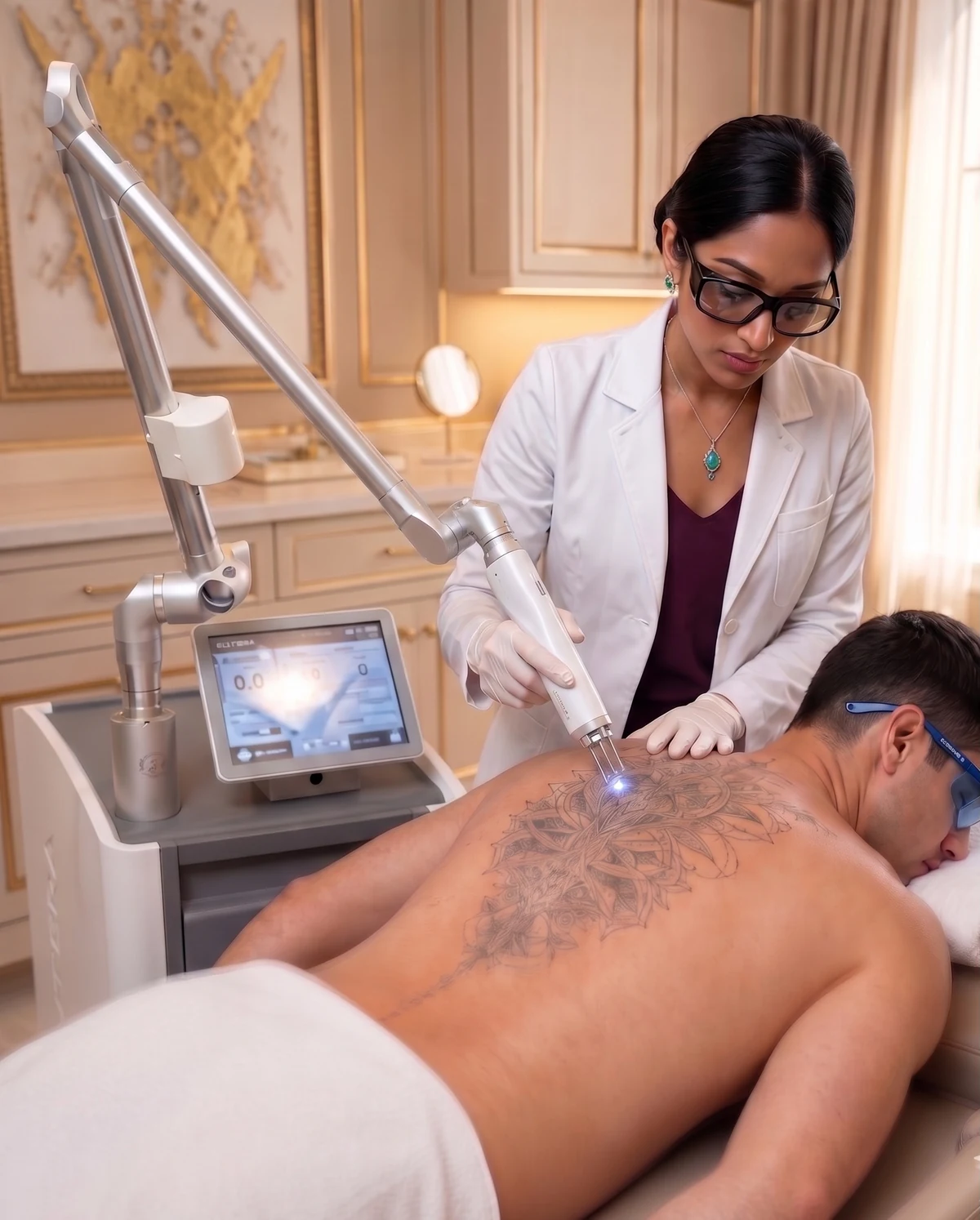
Dr. Jetty assesses your tattoo at consultation based on ink density, color complexity, prior treatment history, anatomic location, and your priorities. Standard Enlighten Tattoo Removal is typically the right choice for amateur tattoos and single-color professional tattoos. The advanced TattooLase protocol is recommended for dense multicolored tattoos, scarred tattoos, cover-ups, and tattoos that have stalled with prior picosecond-only treatment. Both protocols are available at every consultation and both are performed by Dr. Jetty personally.
Both protocols are effective across amateur and professional body tattoos, cosmetic tattoos (microbladed eyebrows, lip blush, permanent eyeliner, scalp micropigmentation), traumatic tattoos, and tattoos that have stalled at other practices. The Cutera enlighten III's three wavelengths cover the full color spectrum including resistant cool tones (greens, sky blues, teals) that most picosecond systems leave behind. The 1064 nm wavelength makes safe treatment of Fitzpatrick IV through VI skin types possible.
At Princeton Aesthetics, you receive the right protocol for your specific tattoo, performed by Dr. Jetty personally, with honest expectations set up front based on published clinical evidence.
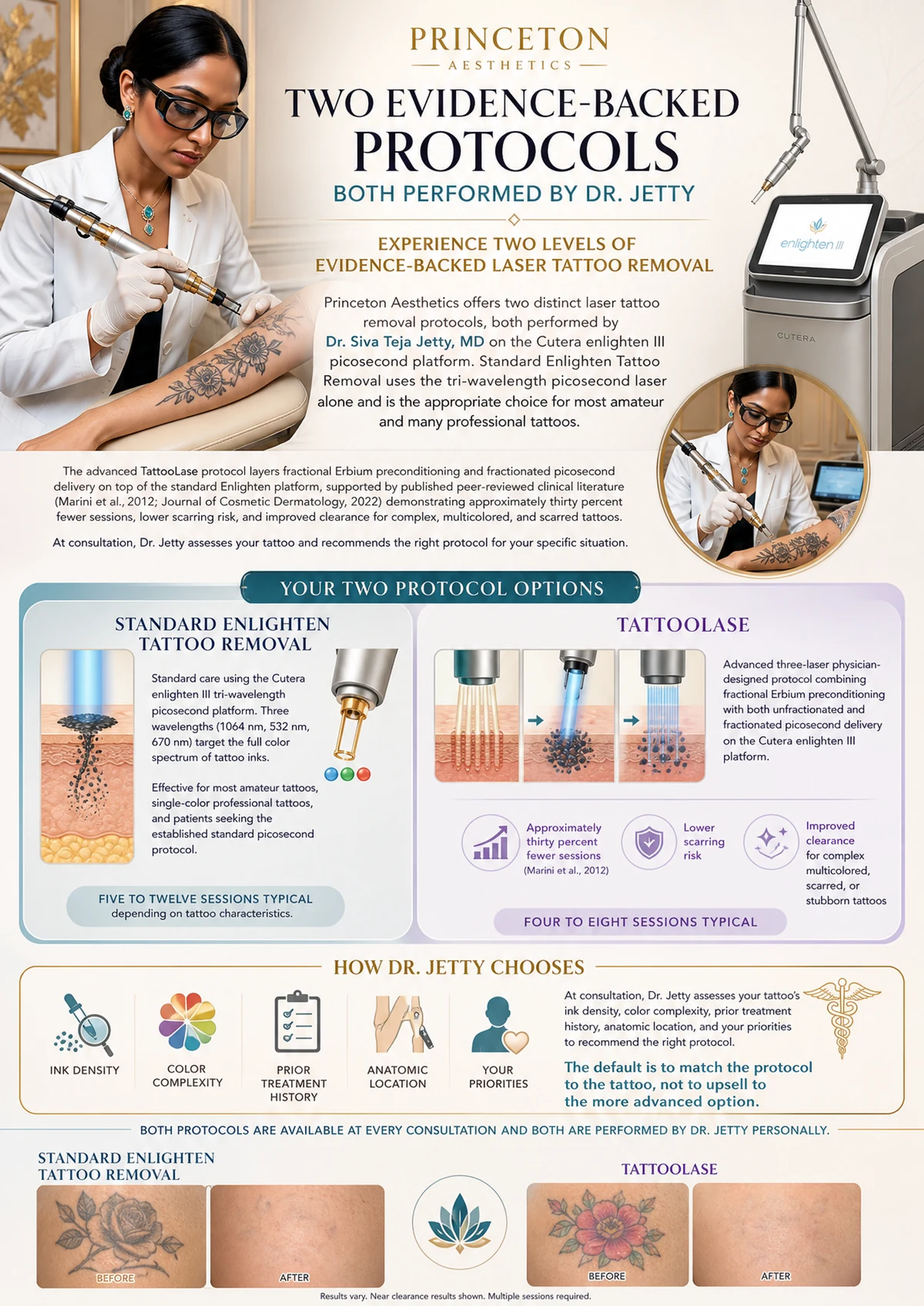
The number of sessions needed to clear a tattoo varies significantly by the tattoo's characteristics. Both protocols deliver more clearance per session as tattoo complexity decreases. The comparison below sets realistic expectations for each tattoo scenario, based on published clinical data and Dr. Jetty's clinical experience. The strongest case for TattooLase is in scarred and complex multicolored tattoos where standard picosecond treatment frequently stalls.
Low ink density, black ink only, superficial depth.
Standard Enlighten: three to five sessions. TattooLase: two to three sessions. The smallest gap between protocols. Either is a reasonable choice. Most patients with simple amateur tattoos do well with Standard Enlighten.
High ink saturation, dense dark lines, deep placement.
Standard Enlighten: six to ten sessions. TattooLase: four to six sessions. TattooLase becomes meaningfully faster here and the Erbium preconditioning reduces the blistering and pain that dense ink loads typically produce with picosecond-only treatment.
Stubborn blues, greens, layered ink, prior cover-up work.
Standard Enlighten: ten to twelve or more sessions. TattooLase: six to eight sessions. The fractionated picosecond step in TattooLase addresses dense layered ink and resistant cool tones that standard treatment cannot fully reach. TattooLase is the preferred protocol for these tattoos.
Pre-existing scar tissue from earlier tattooing or prior removal attempts that traps ink under the skin.
Standard Enlighten: twelve to fifteen or more sessions with high risk of stalling. TattooLase: six to seven sessions. The Erbium preconditioning and fractionated picosecond actively treat the scar tissue itself, which is why TattooLase is strongly preferred for scarred tattoos.
These ranges are estimates. Tattoo size, age, ink chemistry, anatomic location, and prior treatment history all affect the final session count. Dr. Jetty reviews progress at every visit and adjusts the protocol as the tattoo responds. Patients who start with Standard Enlighten can escalate to TattooLase if progress is slower than expected, without changing practices.
Each session begins with wavelength selection based on the tattoo's ink colors. Calibrated picosecond pulses are delivered across the tattoo, with optional Erbium preconditioning and fractionated picosecond layering in TattooLase. Patients describe the sensation as quick warm snaps. Topical numbing is offered when appropriate.
Picosecond pulses are roughly 1,000 times shorter than the nanosecond pulses of older Q-switched lasers. The shorter pulse generates a photoacoustic shock rather than primarily photothermal damage, fragmenting ink into substantially smaller particles with less thermal injury to surrounding skin. Smaller fragments clear faster and with less inflammation.
Three wavelengths cover the full ink color spectrum. 1064 nm targets dark ink and reaches deep into the dermis with minimal epidermal melanin absorption, making it safe for darker skin types. 532 nm addresses warm colors (red, orange, pink, yellow). 670 nm targets resistant cool colors (greens, sky blues, teals) that two-wavelength systems leave behind.
Fractional Er:YAG passes create microchannels that act as pressure relief ducts, preventing the sub-epidermal blistering that limits single-laser tattoo removal at higher energies. Marini et al. (2012) demonstrated that this preconditioning approximately doubles the safe laser energy threshold the skin can tolerate.
Fractionated picosecond delivery at lower fluence triggers Laser-Induced Optical Breakdown in the dermis. The Journal of Cosmetic Dermatology (2022) demonstrated this step improves fifty-percent-clearance rates from 69.2 to 84.6 percent over three sessions and helps break down scar tissue that traps ink in older or previously-treated tattoos.
Over four to eight weeks after each session, your immune system clears the fragmented ink particles via lymphatic drainage. This is why visible fading continues for weeks after each visit and why sessions are spaced rather than performed back to back. Adequate spacing lets the previous session's clearance complete before the next round of fragmentation.
The 1064 nm wavelength used at the core of both protocols carries the broadest published safety record in Fitzpatrick IV through VI skin types. Patients excluded from tattoo removal elsewhere because of darker skin tone are routinely candidates here.
Dr. Jetty performs every tattoo removal session personally. Wavelength selection, fluence titration, and pass sequencing are adjusted at every visit based on how the tattoo is responding. No technician-run sessions, no delegated protocols.
Most patients see meaningful fading within the first two to three sessions. Complete clearance follows the timelines in the comparison above, with Dr. Jetty reviewing progress at every visit and adjusting the protocol as the tattoo responds.
Body art across torso, arms, legs, neck, hands, feet.
The largest patient group. Standard Enlighten is usually appropriate for amateur and single-color professional tattoos; TattooLase is recommended for dense multicolored or large professional pieces.
Microbladed eyebrows, lip blush, permanent eyeliner, scalp micropigmentation.
Treatable with both protocols. Often clears faster than body tattoos because ink load is lighter. Care is required given proximity to sensitive structures.
Stubborn multicolor tattoos, scarred tattoos, partially-removed tattoos from prior treatment elsewhere.
TattooLase is strongly recommended for these cases. The Erbium preconditioning and fractionated picosecond steps actively address the scar tissue and dense ink that standard treatment cannot reach.
Every candidate is reviewed by Dr. Jetty before any session begins. Protocol selection (Standard Enlighten or TattooLase) is part of the consultation. Both options are available at every visit and both are performed by Dr. Jetty personally.
Both Standard Enlighten Tattoo Removal and the advanced TattooLase protocol are available at Princeton Aesthetics. The recommendation always matches your specific tattoo rather than the practice's default offering.
Dr. Siva Teja Jetty, MD performs every tattoo removal session personally. No technician-run sessions, no delegated protocols.
Both protocols are anchored in published peer-reviewed clinical literature (Marini et al., 2012; Journal of Cosmetic Dermatology, 2022). We can show you the studies that support every claim we make.
Industry-leading tri-wavelength picosecond platform covering the full ink color spectrum, including the resistant cool tones (greens, sky blues, teals) that most picosecond systems cannot fully clear.
Including the deeper skin tones where many shorter-wavelength tattoo lasers are not safe. Patients excluded elsewhere because of skin tone are routinely treated here.
Dr. Jetty will tell you if Standard Enlighten is appropriate for your tattoo rather than defaulting to the more advanced TattooLase. The right protocol depends on the tattoo, not on what brings more revenue.
Pay per session. Continue as long as you and Dr. Jetty agree the protocol is working. Switch protocols if needed without losing prepaid session value.
Session count estimates are based on your actual tattoo characteristics, not on a one-size-fits-all average. The comparison table on this page sets honest expectations by tattoo type.
Begin with an educational discovery session at no cost so you understand your options before committing to any treatment.
Written and verbal aftercare guidance after every session. The clinic is available for questions between visits. Aftercare is half the result with tattoo removal.
The same physician assesses your tattoo, performs every session, and reviews progress. Care does not pass through multiple hands.
Patients from Princeton, Plainsboro, West Windsor, Lawrenceville, Hamilton, and beyond. Convenient location with on-site parking.

Princeton Aesthetics was founded by Dr. Jetty on a simple principle: every patient deserves a treatment plan built around their specific goals, anatomy, and needs — not a preset menu.
From laser resurfacing and skin tightening to body sculpting, hair restoration, and wellness treatments, we offer a complete range of services to address all your aesthetic needs under one roof — each designed with physician–level precision.
Whatever brings you here, Dr. Jetty personally oversees every protocol at our practice, ensuring the same clinical standards apply across every service we offer. Serving Princeton, New Jersey and surrounding communities from our Princeton Junction location.
At Princeton Aesthetics, our skin rejuvenation services go beyond mere treatments; they pamper your senses while revitalizing the health and appearance of your skin. Each session is an opportunity to indulge in luxury while achieving visible, lasting results, making our clinic the epitome of skincare excellence.
from 81+ Reviews
Accessibility: If you are visually impaired or have some other impairment and you wish to discuss potential accommodations related to using this website, please contact our office at (609) 874-0017.